
What are the barriers and benefits of using charity support services to outsource response handling for smaller and medium-sized charities?
Key Take-Outs
-
Smaller and medium-sized charities may avoid outsourcing because they worry about cost, complexity, change or losing the personal touch.
-
Outsourced charity support services can help teams manage response handling peaks without adding permanent internal resource.
-
The right partner can improve banking, thanking, data capture, supporter services, reporting and compliance.
-
Outsourcing can help charities protect supporter experience while freeing fundraisers to focus on stewardship and income growth.
-
For charities already outsourcing, reviewing provision can identify whether a different partner could offer better visibility, service or flexibility.
Can charity support services help smaller charities fundraise more?
For smaller and medium-sized charities, response handling often starts as something that happens naturally inside the organisation. A few people open the post, process donations, update supporter records, answer questions and send thank you letters. It feels close, personal and manageable.
Then the programme grows. Appeals become more ambitious. Supporter journeys become more sophisticated. Direct mail, telephone, digital and face-to-face activity may begin to work together. Volumes rise, and peaks become harder to predict. Suddenly, what used to be manageable can begin to feel like a barrier to doing more.
At that point, some charities start to explore external charity support services, including outsourced response handling. Others hesitate — often for very good reasons. Outsourcing can feel like a big step, particularly when supporter relationships are close and budgets are carefully managed.
This blog looks honestly at the barriers smaller and medium-sized charities may feel, and the benefits that can come from working with the right response handling partner.
Barrier 1: “We already handle everything in-house”
This is perhaps the most common reason charities have not explored outsourcing before. If something is already being done internally, and supporters are being cared for, why change it?
The answer is that outsourcing does not have to replace the care, knowledge or warmth within your team. Instead, it can remove the operational pressure that prevents your team from using that knowledge more strategically.
In a recent Woods Valldata webinar, Response Handling for Smaller Charities, Matt Jones described how internal response handling can create capacity challenges for charities: limited ability to scale campaigns, slower banking and thanking at busy times, pressure on supporter services, time-consuming data input, paper storage requirements and the need to keep processes secure and compliant.
None of this suggests an internal team is not doing a good job. Quite the opposite. It usually means the charity has grown to a point where operational systems need to grow too.
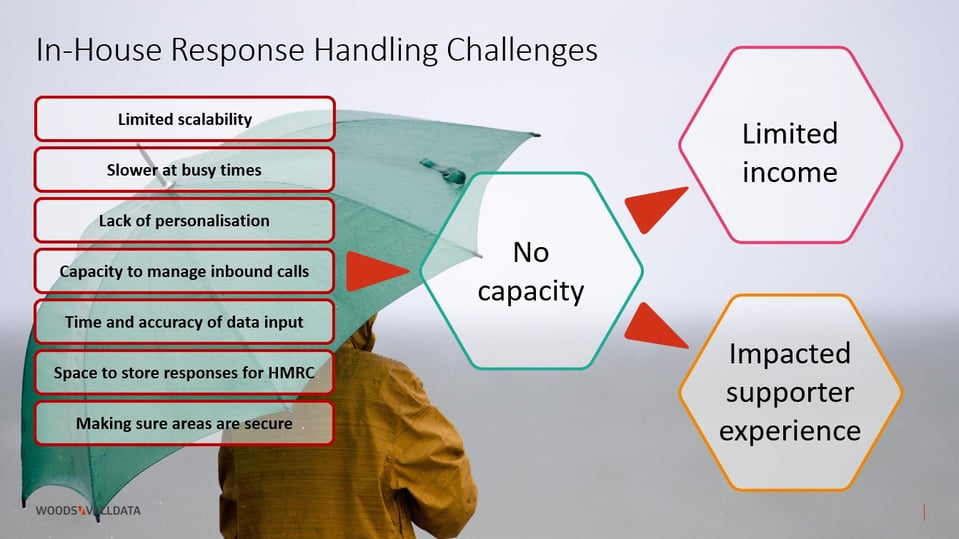
Benefit: your team can focus on fundraising, not fulfilment
When response handling is outsourced well, internal teams can redirect time towards the work that deepens supporter relationships and grows income. That might include improving stewardship, developing propositions, analysing campaign results, testing new approaches, planning supporter journeys or simply having more time for thoughtful supporter care.
Fran Rutherford, Head of Individual Giving at Ethiopiaid, explained in the webinar that outsourcing helps the charity operate as a lean team. They're a charity team of 10, with four team members responsible for fundraising. Rather than having to spend valuable time on administrative post handling and payment processing, the team can focus on stewardship, innovation and planning future activity. She described outsourcing as the way their small team can keep overheads low while focusing on raising more essential income to fund good works in Ethiopia.
That is the value of the right charity support services: they do not take the heart out of the charity. They create space for the charity to use that heart more effectively.
Barrier 2: “It will be too expensive or unpredictable”
Cost is a real concern, especially for smaller charities. Fundraising teams are rightly careful about where budget is spent and what return it can deliver. Outsourcing can feel like adding another supplier cost at a time when every pound needs to work hard.
But the true cost of in-house response handling is not always visible. It includes staff time, training, management time, systems, storage, scanning, compliance, quality control, payment handling, reconciliation and the opportunity cost of fundraisers spending less time on income-generating activity.
For charities considering whether to employ more people or outsource, the comparison should be broad. A new role may be appropriate, but if the main need is operational capacity, outsourced response handling may offer greater flexibility, resilience and specialist expertise.

Benefit: predictable capacity can support growth
One of the reasons Woods Valldata developed ResponseGo was to make outsourced response handling more accessible to smaller and medium-sized charities. ResponseGo provides simple, scalable and affordable response handling designed for smaller charities, with services including post opening, scanning and capture, secure banking, tailored thanking, supporter services, weekly CRM-ready data files, online reporting, campaign management and high standards of compliance.
In the webinar, Matt Jones explained that ResponseGo was designed as fixed cost model so charities can budget and forecast more confidently. That kind of predictability can be important for teams who want to scale their individual giving activity without worrying that stronger response volumes, or additional test campaigns, will automatically create unmanageable operational costs.
As Matt put it, the aim is to offer “a full response handling experience at a predictable cost”.
Barrier 3: “We might lose the personal touch”
For many smaller charities, supporter relationships feel especially personal. Teams may know long-standing donors by name. They may recognise handwriting on response forms. They may feel that outsourcing could make the charity seem distant or transactional.
This concern is valid. Supporter experience matters. The Chartered Institute of Fundraising’s Supporter Experience group emphasises that every interaction contributes to how a supporter thinks and feels about an organisation.
But outsourced response handling should not mean losing personality. It should help charities deliver timely, accurate and relevant supporter communications more consistently. The right partner should understand your tone, your campaign objectives and your supporter journey.
Benefit: personalisation can become easier to deliver
Personalisation is not only about writing a warm message. It is also about having the right data, the right processes and the right variations in place so supporters receive communications that feel relevant.
Woods Valldata’s response handling services combine automated processes with human intervention, helping to capture data accurately while supporting tailored thanking and supporter services. Woods Valldata’s blog on outsourcing charity response handling highlights speed, accuracy, visibility, clear communication and cost efficiency as important benefits of working with a third-party specialist.
Fran Rutherford shared a practical example from Ethiopiaid during the Response Handling for Smaller Charities webinar. She explained that Woods Valldata’s SmartView portal gives the team access to supporter records, gift history, scanned forms, comments and Gift Aid information. That visibility helps the charity maintain continuity when supporters get in touch, even though response handling is outsourced.
This is where outsourcing can enhance, rather than dilute, the personal touch. It can make information easier to access, thanking easier to tailor and supporter service easier to manage.

Barrier 4: “It feels complicated to change supplier or process”
Change takes energy. For charities already under pressure, even positive change can feel like one more project. If a team is handling response management in-house, moving to an external partner can raise practical questions: how will campaigns be briefed, how will data come back, how will the CRM be updated, how will supporter queries be handled, and how much work will onboarding involve?
For charities already outsourcing elsewhere, the barrier may be different. They may be dissatisfied with service, reporting, responsiveness or supporter experience, but uncertain whether changing provider would be disruptive.
Benefit: the right partner makes the process manageable
Outsourcing should simplify, not complicate. In the webinar, Fran Rutherford described Ethiopiaid’s campaign set-up process as straightforward. The charity provides a campaign brief, asks for form codes, agrees variable thanking phrases and receives proofs. She said, “You just send it off, and it will get set up.”
That kind of trust and simplicity matters. Smaller and medium-sized charities do not need more complexity. They need reliable processes, clear communication and a partner who understands the rhythm of fundraising campaigns.
For charities considering a new provider, it is worth asking how onboarding is managed, what data outputs look like, how campaign reporting works, how supporter queries are managed and what level of account management is included. A good partner should be able to answer those questions clearly.
Barrier 5: “We are not large enough to outsource”
Historically, response handling has often felt like a service designed for large charities with high-volume appeals. Smaller charities may assume they do not have enough responses to make outsourcing viable, or that a specialist partner will not be interested in a modest programme.
That perception is changing. As individual giving teams become more ambitious and supporter expectations rise, smaller charities need access to the same operational quality, compliance and supporter care as larger organisations — scaled appropriately for their needs.

Benefit: outsourcing is now more accessible for growing charities
One of the most important shifts in the market is that outsourced response handling no longer needs to be reserved for the largest fundraising programmes. Woods Valldata developed ResponseGo to make professional response handling more accessible to smaller and medium-sized charities, with complete supporter service at a fixed monthly cost. That means charities can benefit from specialist processes, secure banking, tailored thanking, supporter services, weekly CRM-ready data files, online reporting and campaign management without having to build all of that infrastructure themselves.
Matt Jones explained in the webinar that ResponseGo was created because Woods Valldata had received many enquiries from smaller and medium-sized charities, but the traditional response handling model was not always practical for them. The aim was to remove the fear of escalating costs or low return on investment by creating a fixed cost model that supports growth, development and campaign flexibility.
That matters because growth can be unpredictable. A Christmas appeal may perform better than expected. A cold acquisition campaign may generate more first-time supporters than planned. An emergency appeal may create a sudden response peak. A charity should be able to welcome that response as an opportunity, not worry that success will overwhelm the team.
Barrier 6: “Will we still be a priority?”
Smaller and medium-sized charities can sometimes worry that, if they outsource to a partner that also works with larger national charities, they may not receive the same level of care, service or attention. That concern is understandable. When your supporter relationships are hard won, you need to know that every campaign will matter.
In the webinar Q&A, Matt Jones was clear that the service levels for ResponseGo charities remain the same as those for larger charities. He referenced a four-day service level for banking and data capture, followed by a further three days for thanking, creating a seven-day end-to-end process as part of the standard ResponseGo offer.
For charities exploring charity support services, this is an important question to ask of any provider: what does service look like in practice, not only in a proposal? How quickly are donations processed? How quickly are thank you letters issued? What happens at peak times? How are exceptions handled? Who will you speak to if something changes?
Benefit: better visibility supports better fundraising decisions
Response handling is not only about processing what has already happened. It can also give fundraising teams the information they need to make better decisions while a campaign is live and after it has closed.
Access to campaign reporting, source code performance, scanned forms, donation information and supporter interactions can help teams understand how an appeal is performing, what supporters are saying and where follow-up may be needed. It can also make testing easier to evaluate, particularly when campaigns include different segments, messages, response forms or channels.
Fran Rutherford described SmartView as something Ethiopiaid uses “practically every day”. She explained that it helps the team access scanned forms, gift history, comments, address changes and Gift Aid information. Rather than creating distance, that visibility helps the charity stay close to supporters and maintain continuity when someone gets in touch.
That kind of visibility can be especially valuable for smaller teams. If only a few people are responsible for individual giving, supporter care, reporting and future planning, easy access to accurate information can make the whole programme feel more manageable.
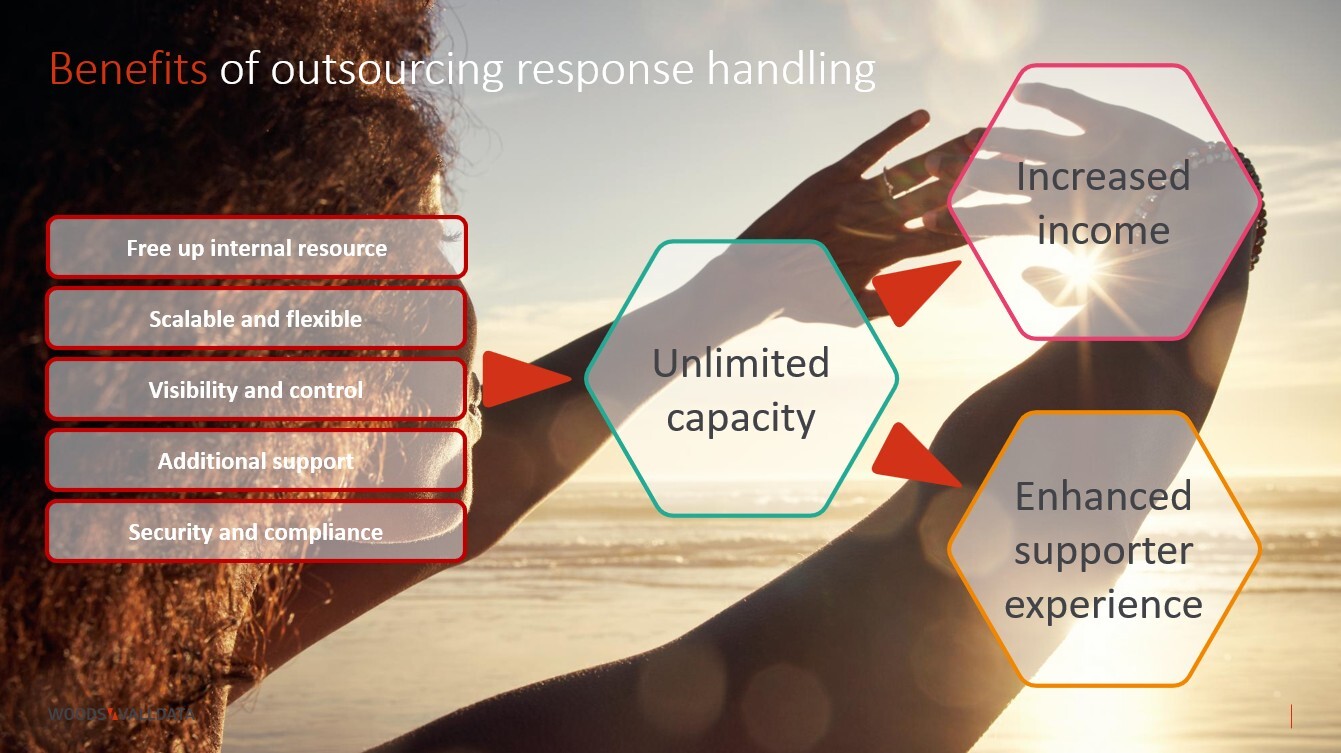
How to decide whether outsourcing is right for your charity
Outsourcing response handling will not be the right answer for every charity at every point. If response volumes are very low and the internal process is working well, it may be sensible to keep things as they are for now. But if response handling is beginning to limit growth, delay thanking, absorb fundraiser time or make compliance feel harder, it is worth exploring. A useful starting point is to ask a few simple questions:
-
Are campaign response peaks becoming harder to manage?
-
Are donations always banked and acknowledged as quickly as you would like?
-
Is your team spending too much time on manual processing?
-
Could your charity grow income if operational capacity was not a limiting factor?
-
Would stronger reporting and visibility help you manage campaigns more confidently?
-
Are security, compliance or physical storage requirements becoming more difficult to manage internally?
-
If you already outsource, is your current provider giving you the service, flexibility and supporter experience you need?
If the answer to several of these questions is yes, it may be time to have a conversation with an organisation like Woods Valldata about what outsourced charity support services could look like for your organisation.

Moving forward without losing what makes your charity special
The best outsourcing partnerships do not ask charities to become less themselves. They help charities protect what matters most: the supporter relationship, the warmth of the thank you, the accuracy of the data, the confidence that gifts are safe, and the ability to grow without stretching teams too far.
For smaller and medium-sized charities, outsourcing response handling can feel like a significant step. But it can also be a positive one: a way to create capacity, protect supporter experience, reduce operational pressure and build a stronger foundation for individual giving growth.
As Fran Rutherford’s experience shows, outsourcing can help a lean team keep overheads low, focus on stewardship and plan for the future. And as Matt Jones explained, the right model can make response handling simpler, more predictable and more accessible for charities ready to take the next step.
At Woods Valldata, we support charities with outsourced fundraising services that help teams do more while making supporters feel appreciated. If you are exploring charity support services, reviewing your current response handling provision or wondering whether your in-house processes are still right for the next stage of growth, we would be very happy to talk.
FAQ: Is it time to outsource response handling?
What are charity support services?
Charity support services are specialist services that help charities deliver operational activity such as response handling, banking, thanking, fulfilment, supporter services, data processing, reporting and compliance support.
Why do smaller and medium-sized charities outsource response handling?
Smaller charities may outsource response handling when internal teams need more capacity, appeal volumes are growing, supporter queries are increasing, or operational tasks are taking time away from fundraising, stewardship and campaign planning.
What are the main barriers to outsourcing response handling for smaller and medium-sized charities?
Common barriers include concerns about cost, unpredictable fees, supplier management, disruption during change, data security, supporter experience and whether outsourced provision will still feel personal to supporters.
What are the main benefits to outsourcing response handling for smaller and medium-sized cahrities?
The benefits can include freeing internal resource, improving speed and accuracy, managing campaign peaks, strengthening supporter experience, improving data visibility, supporting compliance and enabling fundraising teams to scale activity more confidently.
How can outsourced response handling protect the supporter experience?
Outsourced response handling can protect supporter experience by ensuring donations are processed promptly, thank you communications are sent consistently, supporter enquiries are managed professionally, and charity teams have access to accurate information when supporters get in touch.
can Woods Valldata help in outsourcing response handling?
Yes. If your charity is ready to explore whether outsourced response handling could help you protect supporter experience and create capacity for growth, contact Woods Valldata to talk through your programme.
About the Author:
 Helen Halahan is Head of Marketing and PR at Woods Valldata, a company specialising in the full spectrum of outsourced fundraising services for the charity sector including weekly lottery and response handling.
Helen has supported the not-for-profit sector since 2012, including working alongside charity partners to grow and develop their prize-led fundraising programmes. She is a passionate advocate for developing and delivering excellent supporter experience and the impact that brings.
Get in touch with Woods Valldata to find out whether outsourcing response handling is right for your charity - click on the image below.